Advertisements
Did you know that a cat’s tail has roughly 20 to 23 vertebrae, making up almost 10% of all the bones in their body? That’s a whole lot of hardware dedicated to communication! I spent years misreading my cat Oliver’s tail signals, and honestly, it led to more than a few scratches on my arms. Understanding cat tail language meaning completely changed how I interact with him — and every other cat I meet. So let me break down what I’ve learned the hard way.
The Tail-Up Greeting: Your Cat Actually Likes You
When your cat walks toward you with their tail straight up in the air, that’s basically the feline equivalent of a big smile and a wave. It took me embarrassingly long to figure this out. I used to think Oliver was just stretching or something.
A vertical tail position signals confidence, happiness, and a willingness to interact. Sometimes you’ll notice a little hook or curl at the very tip — that’s like the cherry on top, meaning they’re feeling extra friendly. According to research covered by Scientific American, this upright tail posture actually originated as a kitten behavior used to greet their mothers.
The Slow Swish vs. The Fast Whip
Okay, this is where I messed up for years. A slow, gentle swaying tail usually means your cat is focused or mildly interested in something — maybe a bird outside the window or that weird noise from the kitchen. It’s generally a relaxed signal, nothing to worry about.
But a fast, whipping tail? That’s a completely different story. A rapidly thrashing tail means your cat is agitated, overstimulated, or straight-up annoyed. I once kept petting Oliver during one of these moments because I thought he was “wagging” like a happy dog. Spoiler alert: he was not happy, and I got a solid bite on my thumb to prove it.
The Puffed-Up Tail: Halloween Cat Mode
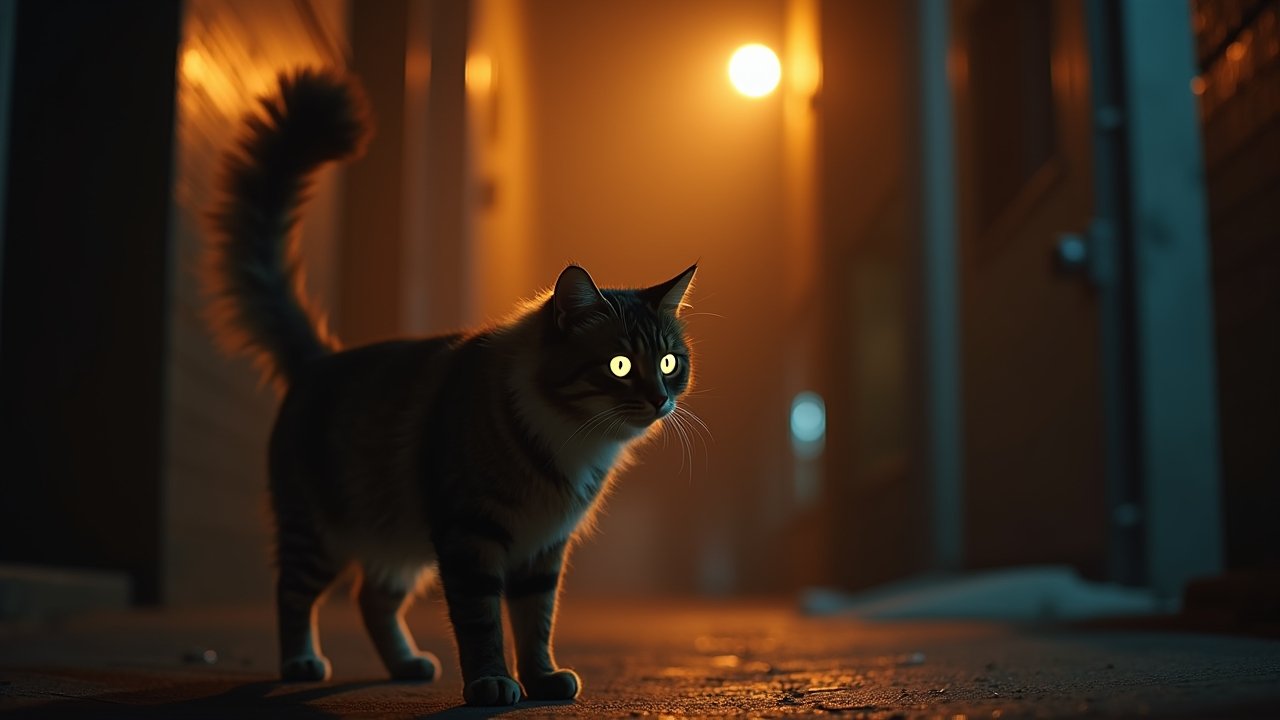
You’ve seen it — the classic bottle-brush tail. When a cat’s tail puffs up to twice its normal size, they’re scared or feeling threatened. It’s called piloerection, and it’s an involuntary response designed to make them look bigger to potential predators.
The first time Oliver puffed up was when my friend brought her dog over unannounced. Poor guy looked like a cartoon character. If you see this, give your cat space and remove whatever’s freaking them out — don’t try to comfort them by picking them up, because you will regret it.
The Low or Tucked Tail: Something’s Wrong
A tail held low to the ground or tucked between the legs usually signals fear, anxiety, or submission. This is one of those cat body language cues that people often overlook. I’ve noticed Oliver does this at the vet’s office every single time without fail.
If your cat’s tail is consistently low at home, it might be worth investigating. Chronic stress, illness, or even pain can cause this behavior. Don’t ignore it — a trip to the vet might be needed.
The Tail Wrap: Feline Hug
This one’s my absolute favorite. When your cat wraps their tail around you — your arm, your leg, whatever — it’s basically a cat hug. It’s a sign of deep affection and trust. Oliver does this when we’re sitting on the couch together, and honestly it makes all those early scratches worth it.
Cats also wrap their tails around other cats they’re bonded with. So if you see this happening in a multi-cat household, those two are legit besties.
Your Cat’s Been Talking This Whole Time
Learning to read feline tail signals honestly feels like unlocking a secret language that was right in front of me for over a decade. Every cat is a little different though, so pay attention to your own cat’s unique patterns and pair tail movements with other cues like ear position and vocalizations. And please, learn from my mistakes — if the tail is whipping, put your hand down.
Advertisements
Want to keep leveling up your cat knowledge? Head over to the Paws Primer blog for more tips on understanding and caring for your furry friends!