

Advertisements
Here’s a stat that blew me away — dogs can learn up to 165 words and signals, according to the American Kennel Club. And yet, there I was three years ago, completely unable to get my golden retriever, Biscuit, to do two of the simplest things on the planet. Sit and stay.
If you’re struggling with basic dog commands like sit and stay, trust me, you are not alone! These foundational obedience skills are honestly the building blocks for everything else in dog training. And once you nail them, life with your pup gets so much easier.
Why “Sit” and “Stay” Are Non-Negotiable
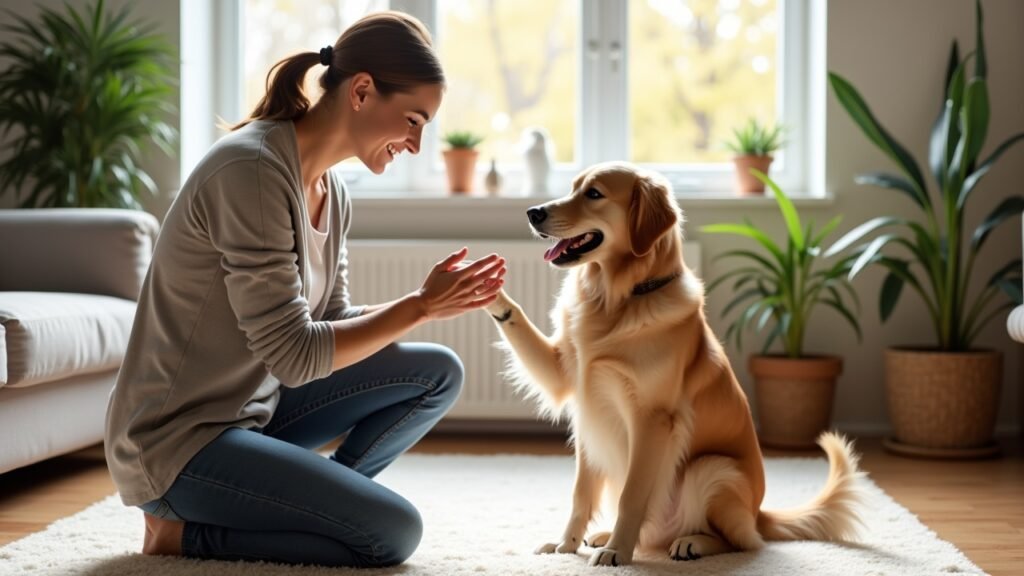
Look, I used to think obedience training was kind of optional. Like, my dog’s happy, I’m happy, what’s the big deal? Then Biscuit bolted out the front door and ran straight into traffic.
Nothing happened, thank God. But that moment changed everything for me. Basic commands like sit and stay aren’t just party tricks — they can literally save your dog’s life.
A solid sit command gives you control in chaotic situations. Stay keeps your dog safe when doors open, when guests arrive, or when you’re at the vet. The Humane Society even lists these as the first commands every dog owner should teach.
Teaching “Sit” — Easier Than You Think
Okay so here’s where I messed up big time at first. I was pushing Biscuit’s butt down while saying “sit” over and over. Turns out, that’s not how positive reinforcement training works at all.
Here’s the method that actually worked for me:
- Hold a treat close to your dog’s nose and let them smell it.
- Slowly move your hand upward so their head follows the treat and their bottom naturally lowers.
- The second their butt touches the ground, say “sit,” give the treat, and shower them with praise.
- Repeat this about five to ten times per session, keeping training sessions short — like five minutes max.
The key here is timing. You gotta mark the behavior the instant it happens. I was way too slow at first, and Biscuit had no clue what she was being rewarded for. Once I got quicker with the treat delivery, everything clicked within maybe three days.
A Quick Tip on Treats
Use small, soft training treats that your dog goes absolutely bonkers for. Biscuit couldn’t care less about her regular kibble during training, but tiny pieces of chicken? She’d do backflips. Whole Dog Journal has a great breakdown on choosing the right training treats if you’re unsure.
The “Stay” Command — Where Patience Gets Tested
Teaching stay was, honestly, where I almost gave up. Biscuit would sit beautifully and then immediately pop back up to follow me. Every single time. It was maddening.
Here’s how I finally got through it:
- Ask your dog to sit first.
- Hold your palm out in front of you like a stop sign and say “stay.”
- Take one step back. Just one. If they hold the position even for two seconds, reward immediately.
- Gradually increase the distance and duration over multiple sessions.
The mistake I kept making was moving too fast. I’d take like five steps back on day one and then get frustrated when she broke the stay. Dogs need you to build up slowly — it’s called progressive training, and it works way better than rushing things.
Advertisements
Also, and this is something nobody told me, practice in boring environments first. I was trying to train stay at the dog park. That’s like asking a kid to do homework at Disneyland.
Consistency Is the Whole Game

One thing that was messing me up was that my partner used different words. I’d say “sit,” he’d say “sit down.” Sounds minor, right? But it confused Biscuit so much. Everyone in your household needs to use the same verbal cues and hand signals.
Short daily practice sessions beat one long weekly one every time. Five minutes a day, and within a couple weeks, you’ll be amazed at the progress.
Your Dog’s Got This, and So Do You
Teaching basic dog commands like sit and stay isn’t about perfection — it’s about building a bond with your pup and keeping them safe. Every dog learns at their own pace, so don’t compare yours to that impossibly well-behaved lab at the park. Adjust these methods to fit your dog’s personality and energy level, and always keep it positive. No yelling, no punishment — just patience and lots of treats.
If you found this helpful, head over to Paws Primer for more posts on pet care, training tips, and everything in between. Your dog’s already a good boy — let’s just give him the tools to prove it!